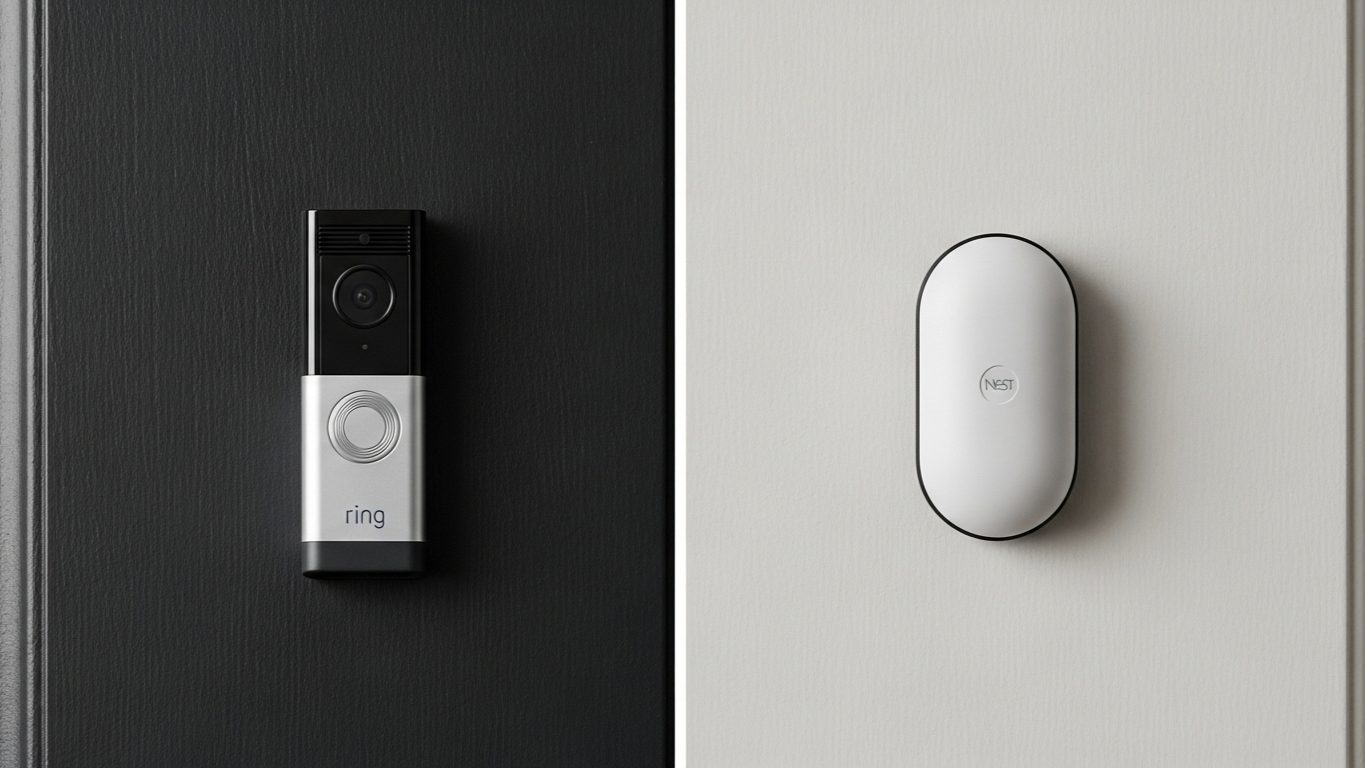
The video doorbell is one of the most personal and critical decisions I help clients make. It’s not just a camera; it’s the digital gatekeeper for their home. It’s their first line of defense, their package protector, and their way of answering the door from anywhere in the world. And in this crowded market, two giants stand above the rest: Amazon’s Ring and Google’s Nest.
I’ve installed, tested, and lived with nearly every model both companies have released. I know their strengths, their weaknesses, and their real-world quirks. Clients often ask me, “Which one is truly better?” The honest answer is that the “better” doorbell depends entirely on your priorities and the smart home ecosystem you’re already invested in.
But they also ask a more direct question: “Okay, but which one do YOU use on your own front door?” For me, after years of hands-on experience, the choice became clear. In this article, I’m going to break down the key battlegrounds between Ring and Nest and reveal which doorbell I ultimately chose for my own home and the precise reasons for that decision.
The Core Battleground: Ecosystem Is Everything
This is the most important factor, and it should be your first consideration. A video doorbell doesn’t live in a vacuum. It’s part of a larger team.
- Team Ring (Amazon): If your home is built around Amazon Alexa, with Echo speakers in every room and perhaps even Ring Alarm or other Ring security cameras, then a Ring doorbell is the native choice. The integration is seamless. When someone presses the doorbell, your Echo devices can announce “Someone is at the front door,” and you can immediately say “Alexa, show me the front door” to see a live feed on an Echo Show.
- Team Nest (Google): If your home is built around the Google Assistant, with Nest Hub displays and Google Nest speakers, a Nest doorbell is the clear winner. The integration is equally elegant. Your Nest Hub will automatically show the live camera feed when the bell is pressed, and you can cast the feed to any Chromecast-enabled TV with a simple voice command.
My Rule of Thumb: Don’t fight the current. If you are deeply invested in one ecosystem, choosing the native doorbell will give you the most fluid and feature-rich experience. Trying to mix and match is possible, but it’s often clunky and misses key features.
Battleground 2: Video Recording and Subscriptions
This is where the two platforms have their most significant philosophical and technical differences. How they record video, and what they give you for free, is a major deciding factor.
Ring’s Approach: Event-Based Recording
Ring Doorbells, by default, are designed to record video only when an event happens: a motion is detected, or the button is pressed. With a Ring Protect subscription, these event clips are saved to the cloud for up to 180 days.
- Pro: This method saves battery life on battery-powered models and reduces the amount of “junk” footage you have to sift through.
- Con: There can be a small gap before a recording starts, and you might miss the few seconds leading up to an event. You can’t scroll back through a 24/7 timeline.
Nest’s Approach: 24/7 Recording (on Wired Models)
The wired Google Nest Doorbell offers a killer feature: the ability to record video continuously, 24/7. With a Nest Aware Plus subscription, you can access a 10-day timeline of non-stop footage.
- Pro: You will never miss a thing. You can scroll back through the entire day and see exactly what happened at any given moment, even if it didn’t trigger a motion event. This is invaluable for piecing together a sequence of events.
- Con: This requires a wired connection (it would destroy a battery) and uses significantly more internet bandwidth. The free plan is also very limited, only offering event snapshots from the last 3 hours.
Note: Newer battery-powered Nest Doorbells operate more like Ring, with event-based recording, but the 24/7 option on the wired model remains a key differentiator.
Battleground 3: The Features That Matte
Beyond the core differences, there are a few unique features that sway many of my clients.
- Ring’s Pre-Roll Feature: To combat the “missed moments” problem, many newer Ring models have a “Pre-Roll” feature that constantly records a low-resolution, silent loop of a few seconds. When an event is triggered, it attaches this pre-roll footage to the main clip, so you can see what happened right before. It’s a clever compromise.
- Nest’s Familiar Face Detection: Nest’s AI is, in my professional opinion, slightly more advanced. The “Familiar Face” detection is exceptional. Once you tag friends and family members, your Nest Hub will announce, “Dad is at the front door.” It adds a personal, welcoming touch that Ring can’t quite match.
- Ring’s App and “Neighbors” Feature: Ring’s app is a mini social network for neighborhood security. The Neighbors feed, where users can post clips and alerts about local activity, creates a sense of community watch that many users find valuable.
My Final Decision and Why I Chose It
So, which doorbell is on my front porch right now? After weighing all the factors for my specific needs, I chose the wired Google Nest Doorbell.
Here’s my personal reasoning, as both a user and a professional:
- I am Deeply Integrated into the Google Ecosystem. My home runs on Google Assistant. I have Nest Hubs in the kitchen and office, and we use Google Photos extensively. The seamless integration—seeing the doorbell feed pop up automatically on the Hubs and having it announce familiar faces by name—was too compelling to ignore. It aligns with the tech my family already uses every day.
- 24/7 Continuous Recording is a Non-Negotiable Feature for Me. This was the single biggest technical deciding factor. As a security-minded professional, I want the full story. I want to be able to scroll back through a timeline and see the car that drove by slowly before the person walked up to my porch. Event-only recording, even with Pre-Roll, leaves potential gaps in the evidence. For me, the peace of mind that comes with a complete, unbroken record is worth the subscription cost and the extra bandwidth.
- The Taller Aspect Ratio. The Nest Doorbell has a more “vertical” field of view than many Ring models. This means I can see a person from head to toe, and I can also see packages left directly at the base of my door—an area some wider-aspect-ratio cameras can miss.
Is the Ring Doorbell a bad product? Absolutely not. It’s a fantastic device, and for clients who are all-in on the Alexa and Ring Alarm ecosystem, it is 100% the right choice. But for my personal use case, the combination of deep Google integration and the robust security of 24/7 recording made the Nest Doorbell the clear winner.
My Advice to You: Choose Your Team First
Don’t just compare a spec sheet of one doorbell versus another. Look at your home holistically.
Ask yourself: Do you live in the world of Alexa or the world of Google Assistant? Do you value the complete, unbroken timeline of 24/7 recording, or is smart, event-based recording sufficient for your needs? Answering those two questions will make your decision much clearer.
Both Ring and Nest make excellent products that will enhance your home’s security. The key is to choose the one that doesn’t just bolt onto your front door but integrates seamlessly into the heart of your smart home.