As a professional Smart Home Integrator, the first question I get from nearly every new client is deceptively simple: “How much does it cost?” The honest answer is, “It’s like asking ‘how much does a car cost?'” You can get a reliable used sedan, a comfortable family SUV, or a luxury sports car. The price ranges dramatically based on your goals, the size of your home, and the level of integration and convenience you desire.
The term “smart home” can be intimidating, conjuring images of six-figure systems seen in magazines. But the reality is that building a genuinely useful smart home has never been more accessible. The key is to stop thinking of it as a single, massive expense and start seeing it as a scalable project that can grow with your needs and budget.
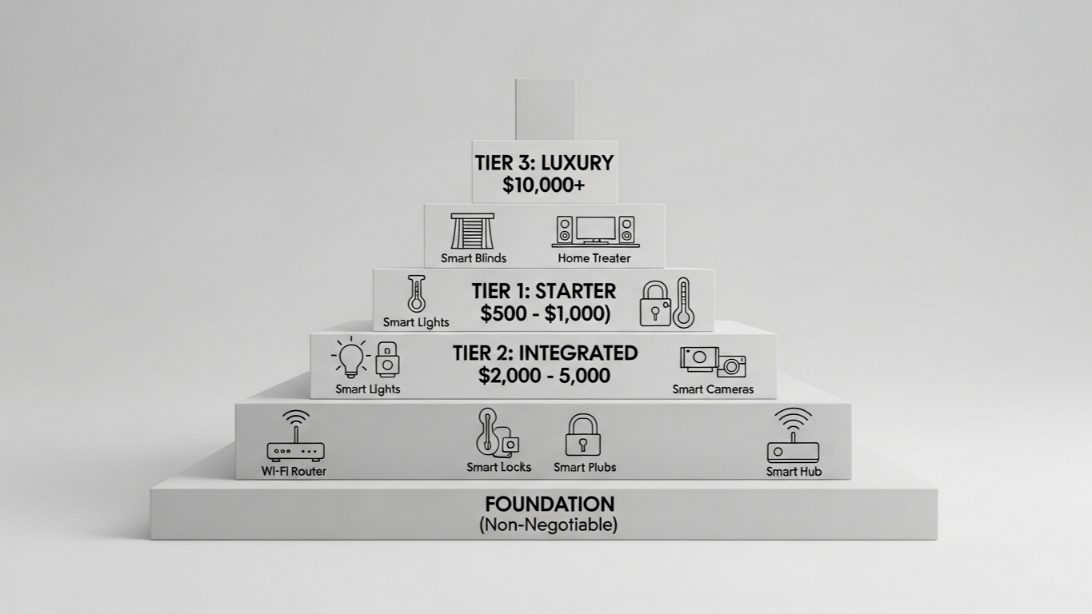
In this guide, I will break down the real-world costs into three distinct tiers, based on hundreds of consultations and installations I’ve performed. We’ll cover a budget-friendly starter setup, a powerful mid-range system for the average family, and a high-end, fully integrated experience.
The Foundation of Every Smart Home: Non-Negotiable Costs
Before we get to the fun stuff, every smart home, regardless of budget, needs a solid foundation. Skimping here is like building a house on sand.
- A Modern Wi-Fi Router or Mesh System: Your ISP’s free router is not good enough for a home with dozens of smart devices. A reliable network is non-negotiable.
- Good: A quality standalone Wi-Fi 6 router: $100 – $200
- Best (My Recommendation): A 3-node mesh Wi-Fi system (Eero, Nest Wifi, Deco): $200 – $400
- A Smart Speaker / Hub: This is the brain and voice of your home. You need at least one.
- Amazon Echo Dot or Google Nest Mini: $30 – $50
Foundation Cost: ~$250 – $450
Tier 1: The “Starter” Smart Home (Budget: $500 – $1,000)
This tier is perfect for apartment dwellers, beginners, or anyone wanting to solve specific problems without a huge investment. The focus here is on convenience and efficiency using affordable, Wi-Fi-based devices.
Goals: Voice-controlled lighting in key areas, simple automation, and basic energy monitoring.
Budget Breakdown:
- Foundation (as above): ~$300
- Smart Lighting:
- 4-pack of Wi-Fi smart bulbs (like Wyze or Kasa) for lamps in the living room and bedroom: ~$40
- 2 Wi-Fi smart dimmer switches (like Kasa or Leviton) for main overhead lights in the kitchen and living room: ~$50
- Smart Plugs:
- 4-pack of smart plugs for “dumb” devices like coffee makers, fans, and holiday lights: ~$30
- 1-2 smart plugs with energy monitoring to find “vampire” devices: ~$25
- Smart Thermostat:
- Amazon Smart Thermostat or a budget model from Wyze: ~$80
- Basic Security:
- 1-2 indoor Wi-Fi security cameras (like Wyze Cam or Blink Mini): ~$70
Total Estimated Cost for Tier 1: $595 (plus foundation)
This setup provides a massive amount of functionality for a minimal investment. You can create “Good Morning” routines that turn on lights and start the coffee maker, and “Goodbye” routines that turn everything off.
Tier 2: The “Integrated” Smart Home (Budget: $2,000 – $5,000)
This is the sweet spot for most homeowners. We move beyond simple Wi-Fi devices and start building a more robust, reliable system using dedicated hubs and protocols like Zigbee or Z-Wave. The focus is on whole-home coverage and deeper automation.
Goals: Reliable whole-home smart lighting, automated climate control, robust security, and seamless multi-room audio.
Budget Breakdown:
- Foundation (Mesh Wi-Fi is a must): ~$400
- Hub-Based System:
- Philips Hue Bridge for lighting: ~$60
- Optional: SmartThings or Hubitat Hub for advanced automation: ~$130
- Smart Lighting (Whole Home):
- Philips Hue starter kit (4 bulbs + Bridge): ~$200
- 10 additional Hue White Ambiance bulbs: ~$250
- 5-8 smart dimmer switches (Lutron Caseta is my pro choice for reliability): ~$400 – $600
- Smart Thermostat:
- Google Nest Learning Thermostat or Ecobee Smart Thermostat with sensors: ~$250
- Security:
- Video Doorbell (Ring or Nest): ~$180
- 2-3 outdoor security cameras (like Ring Floodlight or Arlo Pro): ~$500
- Smart lock (like Schlage Encode or August Wi-Fi): ~$250
- Multi-Room Audio:
- 2-3 Sonos One or Era 100 speakers for key rooms: ~$400 – $750
Total Estimated Cost for Tier 2: ~$2,820 – $3,570 (plus foundation)
This system feels truly “smart.” Your lights work instantly, your thermostat knows when you’re home, and you can secure and monitor your property from anywhere.
Tier 3: The “Luxury” Smart Home (Budget: $10,000+)
This is where we enter the realm of professional-grade, custom-integrated systems. The focus is on absolute reliability, seamless aesthetics, and automating complex tasks. This often involves professional installation and programming from an integrator like myself.
Goals: In-wall/in-ceiling everything, custom-programmed scenes, home theater integration, and automated window shades.
A Personal Note from My Experience: A client recently hired me for a new home build with this level of integration in mind. They didn’t just want smart lights; they wanted lighting that was perfectly tuned to their circadian rhythm. They didn’t just want a smart lock; they wanted a door that would unlock, disarm the security system, turn on a pathway of lights, and start their “Welcome Home” playlist with a single fingerprint scan.
Budget Breakdown (Examples):
- Control System Hub (The Brains): Control4, Savant, or Crestron controller: $1,500 – $4,000+
- Professional Lighting System: A fully wired Lutron RadioRA or Homeworks system can cost $100 – $300 per switch/dimmer, leading to costs of $5,000 – $20,000+ for the whole home.
- Automated Window Shades: This is a true luxury game-changer. Professionally installed smart shades (like Lutron Serena or Somfy) can cost $600 – $1,500 per window.
- Whole-Home Audio/Video Distribution: Systems that send any video source to any TV and any audio source to any in-ceiling speaker can start at $5,000 and go up dramatically.
- Professional Design, Programming & Installation: Labor is a significant cost in this tier. This can range from $2,000 to $10,000+ depending on the project’s complexity.
Total Estimated Cost for Tier 3: Highly variable, but often $15,000 – $50,000+
The value here is in the seamless experience. Everything is managed through one beautiful interface, and the home operates almost invisibly in the background to serve the homeowner’s needs.
My Final Verdict: Start Smart, and Scale Up
The cost of a smart home is not a single number. It’s a journey. My most important piece of advice to any new client is this: start with your biggest pain points.
Is your energy bill too high? Start with a smart thermostat. Do you hate fumbling for light switches in the dark? Start with smart lighting in your entryway. You can build a genuinely useful “Tier 1” smart home for the price of a new TV.
From there, you can expand at your own pace. The beauty of modern smart home technology is its modularity. You can add a new device, a new room, or a new capability whenever your needs and budget allow. The smartest home is one that’s built thoughtfully, over time, to perfectly match the way you live.