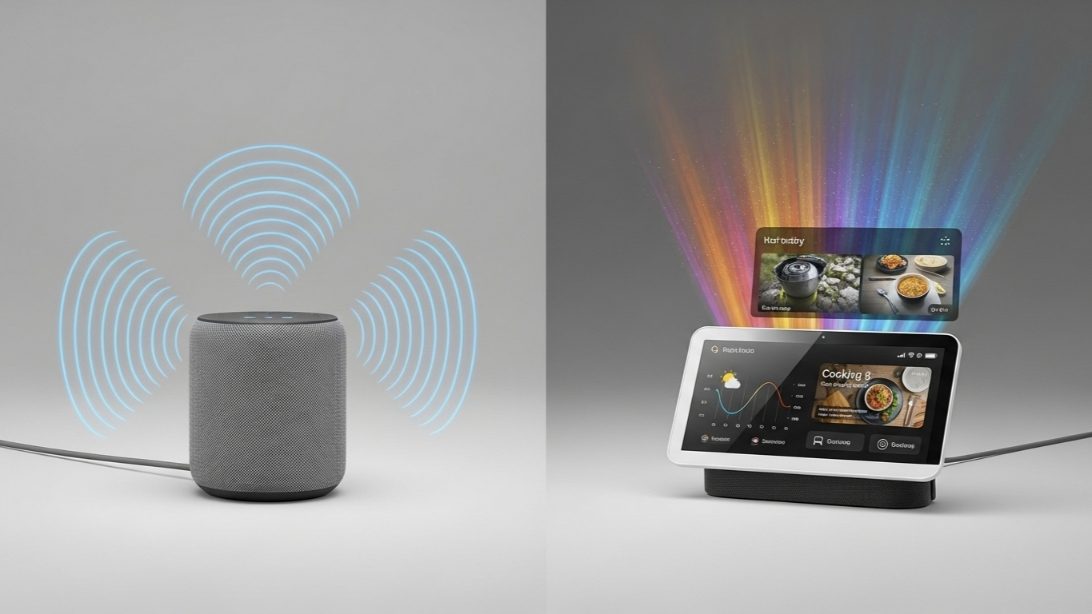
One of the first decisions I help clients make is choosing the “brain” for each room. This usually comes down to a simple but crucial question: do you need a smart speaker or a smart display? While both are powered by the same intelligent assistants (Amazon Alexa or Google Assistant), the addition of a screen fundamentally changes the user experience and the device’s role in your home.
Many people see a smart display, like a Google Nest Hub or an Amazon Echo Show, as just a smart speaker with a screen tacked on. But that’s a vast oversimplification. I encourage my clients to think of them as two completely different categories of devices, each with its own ideal purpose and place in the home.
In this guide, I’ll break down the key differences between these two device types, explore the unique capabilities a screen unlocks, and provide my professional recommendations for which one you should choose for each room in your home.
The Foundation: What They Have in Common
Let’s start with the basics. Both a smart speaker (like an Echo Dot or Nest Mini) and a smart display (like an Echo Show or Nest Hub) share the same core functionality:
- Voice Assistant: Both have Alexa or Google Assistant built-in, ready to answer questions, set timers, and control your smart home devices.
- Microphones: Both have an array of far-field microphones designed to hear your voice commands from across the room.
- Audio Playback: Both can play music, podcasts, audiobooks, and news briefings from a variety of services.
If your needs stop there, a simple smart speaker is a fantastic and affordable choice.
The Great Differentiator: The Power of a Screen
The addition of a touchscreen display transforms the device from a purely auditory experience to a visual and interactive one. This unlocks a whole new layer of functionality. I call this “glanceable information.”
1. Visual Feedback and Deeper Information
This is the most immediate and impactful difference.
- Smart Speaker: “Alexa, what’s the weather?” -> “Currently, it’s 65 degrees and sunny. Expect a high of 72…”
- Smart Display: “Alexa, what’s the weather?” -> The display shows you the current temperature, an icon of the sun, AND the entire 5-day forecast with highs and lows, all on one screen.
The display can show you more information, more quickly, than a voice can tell you. This applies to timers (you can see all your timers counting down at once), calendar appointments, and shopping lists.
2. Video Playback and Communication
This is a capability a smart speaker simply cannot replicate.
- Entertainment: You can watch YouTube videos, follow along with recipes, or stream shows from services like Prime Video or Netflix while you cook.
- Video Calling: A smart display becomes a hands-free video conferencing station. It’s perfect for calling family via services like Amazon Drop In or Google Meet.
- Security Camera Feed: This is a killer feature for home security. When someone rings your video doorbell, a smart display can automatically show you the live feed from the front door, no phone required. You can also say, “Show me the backyard camera” at any time.
3. A Visual Hub for Your Smart Home
While voice is great, sometimes a touch interface is faster. A smart display provides a dashboard for your home.
-
- You can swipe down and see a list of all your smart lights, cameras, and thermostats.
–
- You can tap a button to turn on a room full of lights or adjust the temperature with a slider, without saying a word. This is great for when you need to be quiet at night.
4. The Ambient Display (A Digital Picture Frame)
When you’re not actively using it, a smart display isn’t just a black screen. It becomes a dynamic part of your home’s decor.
- You can have it cycle through your favorite photos from Google Photos or Amazon Photos, turning it into the best digital picture frame you’ve ever owned.
- It can also display beautiful clock faces, weather information, or curated artwork.
A Room-by-Room Breakdown: Where Each Device Belongs
So, which one should you buy? The answer depends entirely on the room and its primary function. Here is the exact advice I give to my clients.
The Kitchen: The Undisputed Kingdom of the Smart Display
My Verdict: Smart Display (Essential)
If you are only going to buy one smart display, put it in the kitchen. This is where the device’s features shine the brightest.
- Following recipes hands-free (YouTube or dedicated recipe apps).
- Setting and visually monitoring multiple timers for different dishes.
- Watching videos or listening to music while you cook and clean.
- Making video calls while your hands are full.
A smart display is a true “kitchen companion” in a way a speaker can never be.
The Bedroom: A Case for “Less is More”
My Verdict: Smart Speaker (Recommended)
I strongly advise my clients to avoid putting a screen on their nightstand. The goal in the bedroom is to wind down and reduce light and stimulation.
- A simple, screen-less speaker like an Echo Dot or Nest Mini is perfect for setting alarms, playing sleep sounds, listening to podcasts, and controlling your lights without adding another distracting screen to your sleep sanctuary.
The Living Room / Family Room: It Depends on Your Style
My Verdict: Either Can Work
This room is a matter of personal preference.
-
- A smart display (like a larger Echo Show 10 or Nest Hub Max) can be a great family hub and digital photo frame.
–
- However, if you already have a large TV, you may not need another screen. A high-quality smart speaker focused on audio (like a Sonos One or an Amazon Echo Studio) might be a better choice for filling the room with music.
The Office, Entryway, or Hallway: A Matter of Function
My Verdict: Smart Display (for Hub-like control), Smart Speaker (for simple commands)
A small smart display near the front door can be a great “command center” for a quick glance at the weather or turning off all the lights as you leave. In a hallway or a room where you primarily just need to issue voice commands, a simple smart speaker is more than sufficient.
My Final Verdict: Choose the Right Tool for the Job
Don’t think of it as “which device is better?” Think of it as “what do I want to do in this specific room?”
A smart speaker is an audio device. It’s a fantastic, affordable way to bring voice control and music into spaces where you listen and speak. A smart display is a visual, interactive hub. It’s a powerful tool for spaces where you watch, see, and do.
By strategically placing the right device in the right room, you create a smart home that is more intuitive, more powerful, and perfectly tailored to the flow of your daily life.