Is the Lymow One Plus Review the Best Robot Mower for Large Yards? A Complete Breakdown
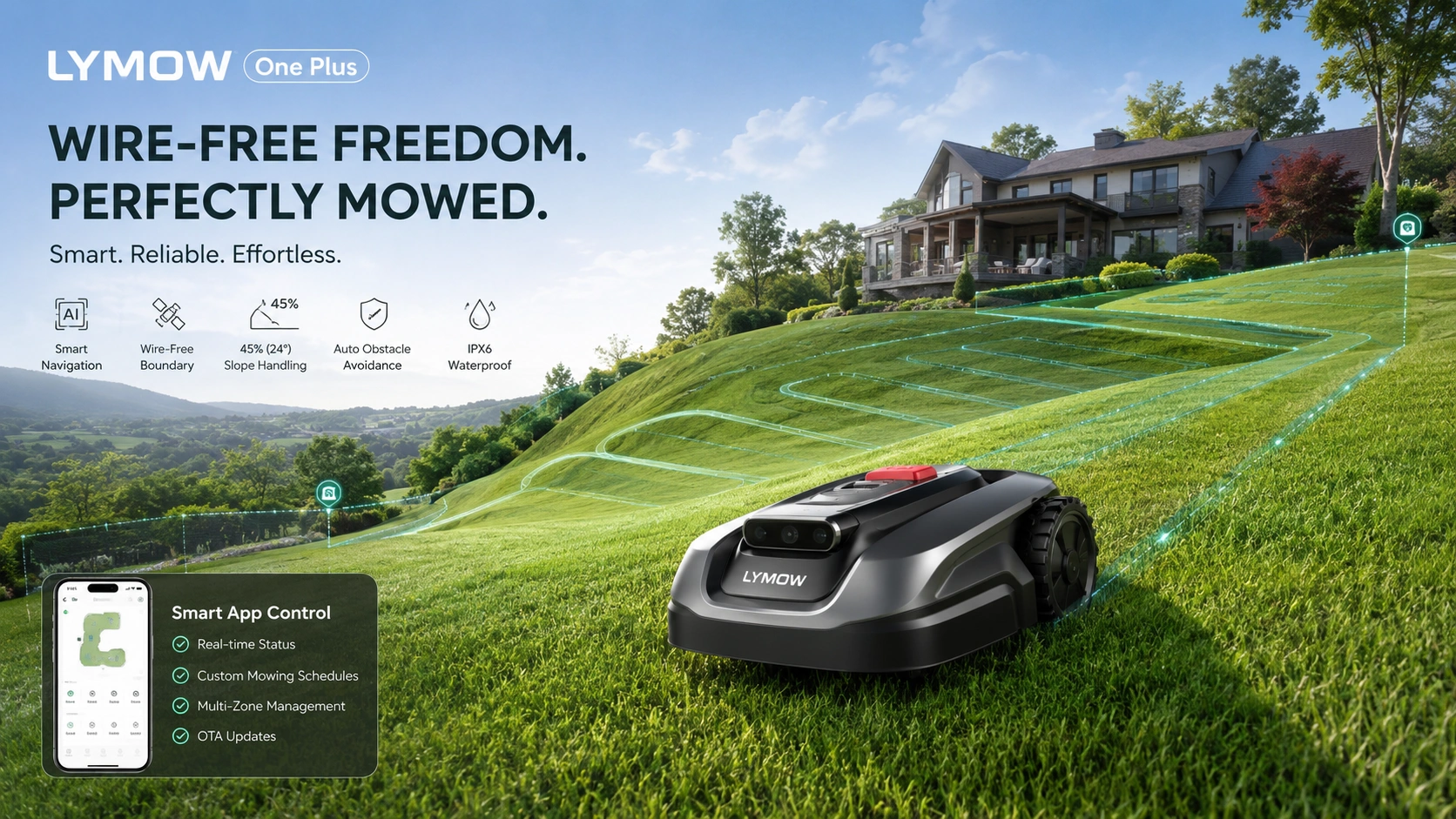
The Lymow One Plus is a premium wire-free robot mower built specifically for large, difficult yards with thick grass, steep slopes, obstacles, and uneven terrain—not small flat suburban lawns. If most robot mowers feel underpowered or frustrating, this machine takes a dramatically different approach.
Robot lawn mowers sound amazing in theory.
Set it up.
Let it mow.
Forget about lawn work.
But reality is often less impressive.
Many robot mowers struggle the moment your yard becomes even slightly challenging.
Common frustrations include:
- boundary wire installation headaches
- weak cutting performance in tall grass
- wheels getting stuck on roots or rough terrain
- poor slope climbing ability
- bumping awkwardly into obstacles
- limited daily coverage
That’s fine for tiny simple lawns.
It’s a disaster for larger real-world properties.
And that’s exactly where the Lymow One Plus enters the conversation.
This isn’t built like a typical lightweight robot mower.
It’s built more like an off-road autonomous lawn machine.
Instead of focusing only on convenience, Lymow seems designed to solve the biggest reasons premium homeowners abandon robot mowing in the first place.
That includes:
- wire-free RTK navigation
- true rotary blade cutting
- tracked terrain mobility
- steep hill climbing
- AI obstacle detection
- massive large-yard coverage
But there’s an important caveat.
This is clearly a premium machine.
Meaning:
It won’t make sense for everyone.
If you have a small flat lawn, this may be serious overkill.
But if you own a demanding property, the value conversation changes dramatically.
In this complete review, we’ll break down setup, cutting power, terrain performance, AI navigation, battery life, alternatives, and whether the Lymow One Plus is actually worth its premium price.
Who Is the Lymow One Plus Actually For?
Let’s make this simple.
The Lymow One Plus is not a robot mower for everyone.
And honestly, that’s a good thing.
Because premium outdoor equipment should solve specific problems—not try to be everything for everyone.
The key question is buyer fit.
Best for Large Properties
This mower clearly targets larger lawns where conventional robot mowers start breaking down.
Strong fit for:
- 0.75-acre yards
- 1-acre properties
- multi-zone large lawns
- complex property layouts
- high-maintenance landscapes
If your yard is expansive, the daily coverage capability becomes a major advantage.
—
Best for Thick Grass Owners
Some robot mowers are really just maintenance trimmers.
They work fine if the grass is already short.
But they struggle badly with:
- dense turf
- fast-growing summer grass
- overgrown sections
- heavier seasonal lawn growth
The Lymow One Plus is built for much more aggressive cutting performance.
That makes it much more practical for real lawn conditions.
—
Best for Rough Terrain & Uneven Yards
This is where the machine becomes especially compelling.
Most robot mowers prefer smooth predictable lawns.
The Lymow appears designed for more demanding environments:
- tree roots
- dips and divots
- branches
- stone edges
- uneven transitions
- rougher landscaping
If your property isn’t perfectly manicured, this matters a lot.
—
Best for Hilly Properties
This is one of the highest-value buyer categories.
Steep yards expose weaker robot mowers fast.
If your lawn includes:
- slopes
- elevated sections
- rolling terrain
- challenging inclines
the Lymow becomes dramatically more relevant.
Its tracked design changes the conversation here.
—
Best for Buyers Who Hate Boundary Wires
Traditional perimeter wire installation is one of the most frustrating robot mower experiences.
Many homeowners simply don’t want to:
- bury wires
- repair damaged boundaries
- reconfigure layouts later
If that sounds miserable, wire-free RTK navigation becomes a huge selling point.
—
Best for Premium Convenience Buyers
This is not bargain equipment.
This is a premium automation purchase.
That means the ideal buyer values:
- time savings
- advanced automation
- better engineering
- less lawn maintenance frustration
Convenience-focused homeowners will understand the value much faster.
—
Who Should Probably Skip It?
This mower is likely overkill for:
- small suburban lawns
- simple flat yards
- budget-conscious shoppers
- users wanting ultra-basic robot mowing
For those buyers, cheaper robot mowers may be perfectly sufficient.
—
Bottom Line
The Lymow One Plus makes the most sense for homeowners with large, demanding, real-world properties—not tiny simple lawns.
Now let’s look at why so many robot mowers fail in exactly these environments.
Why Most Robot Mowers Fail in Large Yards
Robot mowers are easy to love—until your lawn becomes challenging.
That’s where many products fall apart.
Because most robot mowers were originally designed for neat, predictable, low-maintenance lawns.
Not demanding real-world properties.
And that distinction matters.
1. Weak Cutting Systems
This is one of the biggest problems.
Many robot mowers use tiny razor-style blades.
Think:
- box-cutter style blades
- small floating razor discs
These systems work best when mowing constantly in already-maintained grass.
But when grass becomes:
- thick
- tall
- dense
- slightly overgrown
performance drops fast.
Instead of cutting cleanly, weaker mowers often:
- bend grass down
- skip sections
- require pre-cutting
That defeats the point of automation.
—
2. Wheels Get Stuck Constantly
Traditional wheeled robot mowers often struggle with terrain.
Common problem areas:
- tree roots
- small branches
- pavers
- gravel transitions
- dips and ruts
Small wheels + low clearance create reliability headaches.
This gets worse in larger yards with imperfect landscaping.
—
3. Boundary Wire Frustration
Older robot mower setups often depend on perimeter wires.
That sounds manageable—until you actually install them.
Typical frustrations:
- burying wire around the property
- repairing accidental wire damage
- reconfiguring zones later
- handling broken signal sections
For large yards, this becomes especially painful.
—
4. Poor Slope Performance
Hills expose weak robot mowers immediately.
Common failures:
- wheel slip
- traction loss
- stalling mid-slope
- inconsistent mowing patterns
If your property includes aggressive elevation changes, this is a major buying issue.
—
5. Primitive Obstacle Avoidance
Some robot mowers still navigate like early vacuum robots.
Meaning:
- bump into object
- reverse awkwardly
- try new direction
That’s functional—but not exactly intelligent.
In busy yards, this creates inefficiency and frustration.
Examples:
- toys
- sports gear
- garden obstacles
- pet surprises
—
6. Limited Daily Coverage
Battery size matters more than many buyers realize.
Smaller robot mowers may struggle to maintain very large properties efficiently.
That leads to:
- multiple recharge interruptions
- long maintenance cycles
- coverage inconsistency
Large-yard owners notice this quickly.
—
The Core Problem
Most robot mowers are built for easy lawns—not difficult properties.
That’s exactly why premium buyers start looking at machines like the Lymow One Plus.
Because it appears engineered specifically around these weaknesses.
Now let’s look at how the wire-free setup actually works.
Wire-Free Setup & RTK Mapping Review
For many homeowners, robot mower excitement dies the moment setup begins.
Why?
Boundary wires.
Traditional perimeter wire installation is one of the most frustrating parts of owning older robot mowers.
And on larger properties, it becomes even worse.
The Lymow One Plus takes a dramatically cleaner approach.
No Boundary Wires Required
Instead of relying on buried perimeter wires, the Lymow uses:
- RTK positioning technology
- a dedicated RTK pole
- a charging/base station
This changes setup completely.
No digging.
No wire routing.
No future wire repairs.
No perimeter redesign headaches.
For large-yard owners, this alone can be a massive upgrade.
—
What Is RTK? (Simple Explanation)
RTK sounds technical—but the idea is easy to understand.
Think of it as ultra-precise GPS for your robot mower.
Normal GPS can be inaccurate by several feet.
That’s not acceptable for lawn navigation.
RTK dramatically improves positioning accuracy to near centimeter-level precision.
That means the mower can understand exactly where it is inside your property instead of wandering vaguely.
This makes structured autonomous mowing much more realistic.
—
RC-Car Style Mapping (Huge Usability Win)
This may be one of the most user-friendly setup features.
Instead of complicated mapping procedures, the setup behaves much like controlling an RC car.
Using the mobile app, you manually drive the mower around your lawn boundaries.
The mower records the perimeter.
That’s it.
This feels dramatically simpler than older installation-heavy systems.
—
Multi-Zone Flexibility
Large yards are rarely one perfect rectangle.
Real properties often include:
- front lawn + backyard
- side yard sections
- garden pathways
- driveway crossings
- obstacle-heavy zones
The Lymow appears built for this complexity.
Custom setup options include:
- multiple mowing zones
- no-go zones
- navigation channels
- cross-property travel paths
This makes the system much more realistic for non-trivial properties.
—
Fast Initial Setup
Based on the provided workflow, initial setup takes roughly:
15 minutes.
That’s remarkably fast for a machine designed for large-yard autonomy.
Especially when compared with traditional boundary wire installation projects.
—
Why This Matters in Real Ownership
Setup friction often kills smart outdoor product satisfaction.
If installation feels painful, enthusiasm drops immediately.
Lymow’s wire-free approach solves one of the category’s biggest emotional pain points.
—
Potential Trade-Offs
To stay balanced:
RTK systems can sometimes depend on:
- good signal conditions
- proper station placement
- clean sky visibility
Very dense tree cover or signal interference may matter depending on property layout.
But overall, the convenience advantage is substantial.
—
Bottom Line
The Lymow One Plus makes robot mower setup dramatically more approachable by replacing boundary wire headaches with fast RTK-based app mapping.
Now let’s look at where this mower becomes truly different: cutting performance.
Cutting Performance Review: Where the Lymow One Plus Changes the Game
Let’s be honest.
Many robot mowers don’t actually “mow” in the traditional sense.
They maintain already-short grass.
That’s not the same thing.
And if your lawn gets thick, fast-growing, or slightly overgrown, weaker machines can struggle badly.
This is where the Lymow One Plus appears dramatically different.
—
Dual Rotary SK5 Blade System
This is arguably the biggest differentiator.
Most consumer robot mowers rely on tiny razor-style blades.
Think:
- box-cutter-like blades
- small floating razor discs
- light trimming systems
These work for frequent maintenance mowing.
But they’re often weak against tougher grass conditions.
The Lymow takes a much more serious approach.
Instead of miniature blades, it uses:
- dual full-size rotary cutting blades
- SK5 high-carbon tool steel construction
- up to 6,000 RPM rotational speed
That puts it much closer to “real mower” cutting behavior than typical robot trimmers.
—
Why Blade Design Matters
Cut quality isn’t just about speed.
It’s about blade behavior.
Small lightweight blades often:
- deflect under heavier load
- push grass downward
- struggle in denser growth
Larger rotary systems typically cut more decisively.
That’s a major advantage in demanding lawns.
—
Cyclone Cutting System
This is another smart engineering detail.
The mower reportedly creates upward airflow before cutting.
Simple explanation:
Instead of flattening grass, airflow helps lift it upright before the blades strike.
That matters because flattened grass often causes uneven cutting.
A lifted blade profile creates cleaner results.
Especially in thicker turf.
—
No Pre-Cutting Required
This is where premium buyers will pay attention.
Many robot mowers assume your lawn is already under control.
If grass gets too tall, some owners must pre-cut manually first.
That defeats automation entirely.
The Lymow appears designed to chew through tougher conditions immediately.
That makes it much more realistic for real ownership—not ideal demo conditions.
—
More Powerful Motor Performance
Based on the provided specifications, the cutting system offers significantly more power than typical lightweight competitors.
That translates into practical benefits like:
- better dense grass cutting
- stronger consistency
- improved heavy-load performance
- more realistic autonomous mowing
—
Leaf Mulching Capability
This is a surprisingly valuable bonus.
If the mower can effectively mulch leaves alongside grass maintenance, seasonal usefulness increases dramatically.
That improves ROI for larger properties.
—
Lymow vs Typical Robot Mower Cutting
| Feature | Typical Robot Mower | Lymow One Plus |
|---|---|---|
| Blade type | tiny razor blades | dual rotary blades |
| Grass handling | best on short maintained lawns | designed for thicker growth |
| Tall grass recovery | often weak | much stronger |
| Cut consistency | can flatten grass | cyclone lift cutting |
| Leaf handling | limited | leaf mulching capable |
—
Bottom Line
If cutting performance is your biggest concern, the Lymow One Plus appears far closer to a true autonomous mower than a lightweight maintenance robot.
Now let’s see whether the tracked system actually delivers on rough terrain and steep slopes.
Terrain & Slope Performance Review: Built for Difficult Yards?
This is where the Lymow One Plus starts looking dramatically different from traditional robot mowers.
Because rough terrain is exactly where many competing products fail.
Small wheels.
Low ground clearance.
Poor traction.
Weak slope climbing.
That combination creates frustration fast.
Lymow appears engineered specifically to solve those problems.
—
Track Drive System Instead of Wheels
This is the most obvious mechanical difference.
Most robot mowers use conventional wheels.
The Lymow uses continuous tracks.
That matters enormously.
Tracked systems generally offer:
- better traction
- more stable grip
- improved obstacle climbing
- less wheel slip on uneven terrain
That makes the mower feel much closer to off-road equipment than a lightweight lawn gadget.
—
2.7 Inches of Obstacle Clearance
Ground clearance is one of the most overlooked robot mower specs.
But in real yards, it matters constantly.
Typical obstacles include:
- tree roots
- fallen branches
- paver edges
- stone transitions
- uneven lawn borders
Low-clearance robot mowers often get stuck repeatedly.
That kills autonomy.
The Lymow’s higher clearance dramatically improves survivability in rough conditions.
—
Real Rough Terrain Capability
This is where tracked mobility becomes especially valuable.
Properties are rarely perfect.
Even expensive homes often have:
- dips
- divots
- awkward transitions
- landscape imperfections
Traditional wheeled mowers can struggle badly here.
Lymow’s chassis appears built for this reality.
—
Floating Cutting Deck
This is another premium engineering detail.
Without a floating deck, robot mowers can scalp uneven lawns badly.
That happens when rigid cutting systems fail to follow surface contours.
The floating deck helps the mower adapt to changing terrain height more naturally.
Practical benefits include:
- cleaner cut consistency
- less scalping
- better uneven-ground performance
This is especially important for imperfect properties.
—
Extreme Slope Handling
This is one of the biggest premium differentiators.
According to the provided specs, the Lymow can handle slopes up to:
45 degrees.
That’s extremely aggressive for robot mowing.
For perspective:
Many mainstream robot mowers struggle far earlier.
If your property includes:
- rolling hills
- elevated lawn sections
- steep embankments
- challenging terrain transitions
this capability becomes highly relevant.
—
Why Hills Break Most Robot Mowers
Common failure points:
- wheel spin
- traction loss
- sliding downhill
- navigation confusion
- stalled climbs
Tracked mobility changes this equation significantly.
—
Lymow vs Typical Terrain Performance
| Terrain Feature | Typical Robot Mower | Lymow One Plus |
|---|---|---|
| Mobility system | wheels | continuous tracks |
| Obstacle clearance | lower | 2.7 inches |
| Rough terrain confidence | limited | strong |
| Steep slope capability | moderate | up to 45° |
| Uneven lawn adaptation | basic | floating deck |
—
Who Benefits Most?
This matters most for:
- hilly properties
- large uneven lawns
- older landscapes
- yards with roots and rough transitions
- buyers frustrated by stuck robot mowers
—
Bottom Line
If your yard includes hills, rough terrain, roots, or obstacle-heavy landscaping, the Lymow One Plus appears dramatically better equipped than typical consumer robot mowers.
Now let’s look at whether the AI obstacle avoidance is actually smart—or just marketing hype.
AI Obstacle Avoidance Review: Actually Smart or Just Marketing?
This is one of the most important premium robot mower questions.
Because obstacle avoidance quality dramatically affects real ownership satisfaction.
A mower that constantly gets confused, stuck, or crashes into things quickly becomes annoying instead of helpful.
The Lymow One Plus claims a much more advanced approach.
And on paper, it looks meaningfully different.
—
How Basic Robot Mowers Handle Obstacles
Let’s be honest.
Many traditional robot mowers aren’t truly intelligent.
Their obstacle “strategy” often looks like this:
- hit object
- stop
- reverse
- turn randomly
- try again
That technically works.
But it’s primitive.
And in active yards, it becomes inefficient fast.
Examples:
- kids’ toys
- soccer balls
- garden tools
- fallen gear
- pet obstacles
—
Proactive AI Visual Detection
The Lymow claims a much more advanced model.
Instead of waiting to physically collide, the mower uses visual AI detection to identify obstacles in advance.
That changes the navigation experience significantly.
Meaning:
see obstacle → plan avoidance → steer around it cleanly
instead of:
crash → reverse → recover awkwardly
That’s a meaningful difference.
—
Recognizing Real Yard Obstacles
According to the provided specs, the system can detect common real-world objects like:
- soccer balls
- helmets
- frisbees
- general yard clutter
This is exactly the kind of unpredictability robot mowers struggle with in family homes.
—
Moving Object Detection (Important Safety Upgrade)
This is arguably even more important.
Static object avoidance is useful.
But moving-object awareness matters more for safety.
Examples:
- children
- pets
- unexpected movement
According to the feature set, the mower can:
- detect movement
- slow down
- redirect path safely
That’s exactly what premium autonomous equipment should do.
—
Upgraded Camera Hardware
AI is only as good as sensor quality.
Lymow appears to address two common outdoor camera problems.
Anti-Glare Lens Protection
Direct sunlight can blind outdoor optical systems.
That creates navigation failures.
The anti-glare treatment helps maintain visual reliability.
Heated Lens for Morning Fog
This is a surprisingly smart feature.
Outdoor robotics often struggle with condensation.
A fogged lens reduces AI effectiveness immediately.
Lens heating helps maintain visibility.
—
RTK + VSLAM Precision Navigation
Obstacle avoidance doesn’t work well without strong positioning awareness.
The Lymow combines:
- RTK precision positioning
- visual spatial mapping (VSLAM)
This layered navigation approach improves path confidence significantly.
Simple explanation:
- RTK = where am I?
- VSLAM = what do I see?
Together, that creates smarter navigation logic.
—
Lymow vs Basic Obstacle Avoidance
| Obstacle Feature | Basic Robot Mower | Lymow One Plus |
|---|---|---|
| Obstacle handling | bump-and-reverse | proactive visual avoidance |
| Moving object awareness | limited | yes |
| Sunlight resistance | often weaker | anti-glare camera |
| Fog resistance | rare | heated lens |
| Navigation intelligence | basic | RTK + VSLAM |
—
Bottom Line
If real-world AI navigation matters, the Lymow One Plus appears significantly more advanced than older bump-based robot mowers.
Now let’s look at long-term ownership: durability, battery life, and maintenance realities.
Battery Life, Durability & Maintenance Review
A premium robot mower isn’t just about cutting performance.
It’s about long-term ownership.
Because an expensive machine that becomes unreliable after a season is a terrible investment.
The Lymow One Plus appears intentionally built around durability—not disposable gadget design.
And that matters.
—
Built Like a Tank
This is one of the strongest premium positioning signals.
Many consumer robot mowers feel lightweight.
Sometimes almost toy-like.
Plastic-heavy construction may be acceptable for small lawns—but it inspires less confidence in demanding environments.
The Lymow takes a different approach.
It reportedly uses an automotive-grade frame instead of a cheap lightweight shell.
That suggests stronger durability under:
- rough terrain stress
- outdoor weather exposure
- obstacle impacts
- heavy-duty long-term use
For premium buyers, this is reassuring.
—
IPX6 Waterproof Protection
Outdoor autonomy only works if weather resilience is realistic.
Because lawns don’t exist in perfect sunshine.
Rain happens.
Morning moisture happens.
Wet grass happens.
The IPX6 waterproof rating improves ownership confidence significantly.
That means stronger protection against water exposure compared to less weather-ready equipment.
For real-world outdoor robotics, this is important.
—
Self-Cleaning Track System
This is a surprisingly practical engineering detail.
Tracked systems are excellent for mobility—but debris buildup can become a maintenance concern.
Lymow appears to address that directly.
The mower includes:
- under-fender nylon cleaning brushes
- track debris management design
- protective guard plate shielding
This reduces one of the obvious ownership worries.
Less manual cleaning friction = better long-term satisfaction.
—
Battery Technology Matters More Than Buyers Realize
Not all robot mower batteries are equal.
And chemistry matters a lot.
The Lymow uses a Lithium Iron Phosphate (LiFePO4) battery.
That’s notable because LiFePO4 typically offers advantages like:
- longer cycle life
- better durability
- stronger thermal stability
- slower long-term degradation
For expensive outdoor equipment, this is a strong premium choice.
—
2,000+ Charge Cycle Longevity
This is a major ownership advantage.
Battery replacement costs can become painful in robotic equipment.
A higher cycle-life battery dramatically improves long-term value.
Especially for frequent-use large-yard owners.
—
Fast Charging Performance
Coverage depends on recharge efficiency.
The included 10-amp fast charger helps reduce downtime between mowing sessions.
That’s critical for larger properties.
Because slow charging can cripple autonomous coverage efficiency.
—
Massive Daily Coverage
According to the provided specifications, the mower can cover up to:
1.73 acres per day.
That’s substantial.
This is exactly the type of capability large-property buyers care about.
Because weaker robot mowers often spend too much time:
- charging
- recovering
- struggling to finish zones
Coverage scale is a major premium differentiator.
—
Maintenance Reality Check
No robot mower is zero-maintenance.
That’s important to say clearly.
Owners should still expect:
- blade inspection / replacement
- occasional cleaning
- software updates
- seasonal maintenance checks
But the engineering suggests lower friction than many traditional systems.
—
Bottom Line
The Lymow One Plus appears designed for serious long-term ownership, with premium battery chemistry, weather durability, self-cleaning track engineering, and true large-property coverage.
Now let’s compare it directly against traditional robot mowers.
Lymow One Plus Review vs Traditional Robot Mowers: What’s Actually Different?
At first glance, all robot mowers may seem similar.
Autonomous mowing.
App control.
Charging dock.
Automatic lawn maintenance.
But once you compare engineering decisions, the differences become dramatic.
The Lymow One Plus clearly targets a very different buyer than traditional consumer robot mowers.
—
1. Boundary Wires vs Wire-Free RTK Navigation
This is one of the biggest category differences.
Traditional robot mowers often require perimeter wire installation.
That creates:
- installation frustration
- future repair headaches
- reconfiguration pain
- large-yard complexity
Lymow removes that entirely.
Instead, RTK navigation + app mapping make setup dramatically cleaner.
That’s a major usability upgrade.
—
2. Maintenance Trimming vs Real Cutting Power
Many traditional robot mowers are designed for constant light maintenance.
Meaning they work best when grass stays short.
If growth gets aggressive, performance can collapse.
Lymow takes a more serious mowing approach:
- dual rotary blades
- higher cutting power
- thick grass capability
- leaf mulching potential
This makes it much more realistic for demanding lawns.
—
3. Wheels vs Tracks
This is one of the most visually obvious differences.
Traditional robot mowers usually rely on wheels.
That works fine—until terrain gets ugly.
Then you see:
- wheel spin
- stuck recoveries
- poor traction
- slope failures
Lymow’s continuous tracks fundamentally change mobility expectations.
—
4. Basic Obstacle Avoidance vs Vision AI
Older obstacle avoidance often behaves like primitive robotics:
- bump
- reverse
- retry
Lymow appears much more advanced.
With proactive visual AI, the mower can identify obstacles before contact.
That improves:
- efficiency
- safety
- navigation smoothness
—
5. Limited Slope Performance vs Aggressive Terrain Capability
Steep yards are a traditional robot mower weakness.
Traction limitations become obvious fast.
Lymow’s tracked chassis + steep climbing capability create a completely different performance category.
—
6. Lightweight Construction vs Heavy-Duty Durability
Not every robot mower is built for years of rough outdoor punishment.
Some prioritize lightweight convenience.
Lymow appears built around durability:
- automotive-grade construction
- weather resistance
- self-cleaning track maintenance
- premium battery longevity
—
Side-by-Side Comparison
| Feature | Traditional Robot Mower | Lymow One Plus |
|---|---|---|
| Boundary setup | perimeter wire | wire-free RTK |
| Navigation | basic GPS / wire logic | RTK + VSLAM |
| Cutting system | small razor blades | dual rotary SK5 blades |
| Terrain mobility | wheels | continuous tracks |
| Slope handling | moderate | up to 45° |
| Obstacle avoidance | bump-and-reverse | proactive AI vision |
| Durability | consumer-grade | heavy-duty design |
| Large-yard suitability | limited | excellent |
—
Who Should Choose a Traditional Robot Mower?
To stay balanced, traditional models still make sense for:
- small lawns
- flat suburban yards
- budget-conscious buyers
- simple maintenance mowing
Not everyone needs extreme capability.
—
Who Should Choose Lymow?
Lymow makes more sense for buyers with:
- large properties
- challenging terrain
- thick grass
- hills
- premium automation expectations
—
Bottom Line
The Lymow One Plus is not just a better traditional robot mower—it’s closer to a completely different category of autonomous lawn machine.
Now let’s look at the honest pros and cons.
Pros and Cons of the Lymow One Plus
No premium product is perfect.
And honestly, expensive outdoor equipment deserves extra scrutiny.
The Lymow One Plus appears extremely capable—but buyers should understand both the strengths and the trade-offs before making a premium purchase.
Here’s the realistic breakdown.
—
What the Lymow One Plus Gets Right
1. Truly Built for Large Difficult Yards
This is the biggest differentiator.
Many robot mowers target ideal lawns.
Lymow targets demanding properties.
That’s a completely different design philosophy.
Strong fit for:
- large acreage-style lawns
- rough terrain
- complex layouts
- challenging real-world properties
—
2. Real Cutting Power
This appears dramatically stronger than typical robot mower cutting systems.
Key advantages:
- dual rotary blades
- SK5 high-carbon steel
- high RPM cutting
- cyclone lift airflow
- thick grass handling
This makes it feel much closer to true mowing equipment than maintenance-only trimming robots.
—
3. Exceptional Terrain Capability
The tracked mobility system changes expectations significantly.
Benefits include:
- strong traction
- root climbing
- branch handling
- better obstacle clearance
- steep hill capability
For rough properties, this is huge.
—
4. Wire-Free Setup Is a Major Usability Win
Boundary wire frustration has hurt this entire category for years.
Removing that friction dramatically improves buyer appeal.
Fast app mapping makes onboarding much cleaner.
—
5. Advanced AI Navigation
The proactive obstacle avoidance appears far more sophisticated than bump-and-reverse legacy designs.
That improves:
- safety
- efficiency
- navigation confidence
- family-home practicality
—
6. Premium Long-Term Hardware Design
Battery chemistry, weather durability, and self-cleaning engineering all suggest thoughtful ownership design.
This matters at premium pricing.
—
Potential Downsides
1. Premium Price Barrier
Let’s start with the obvious.
This is not a budget robot mower.
Buyers with smaller lawns may struggle to justify the investment.
Capability comes at a premium.
—
2. Overkill for Simple Yards
If your lawn is:
- small
- flat
- simple
- easy to maintain
this machine likely exceeds your needs significantly.
Paying for extreme capability you’ll never use rarely makes sense.
—
3. RTK Dependency Considerations
Wire-free navigation is fantastic—but RTK systems depend on proper conditions.
Potential environmental considerations include:
- signal visibility
- station placement
- heavy tree canopy complexity
Some properties may require more planning.
—
4. Advanced Features May Increase Learning Curve
This is a sophisticated machine.
Features like:
- zone mapping
- navigation management
- AI obstacle settings
- multi-area planning
may feel more complex than ultra-basic entry-level robot mowers.
—
5. Premium Category Means Higher Expectations
At this price level, buyers expect excellence.
That means tolerance for software quirks or setup friction becomes much lower.
Premium positioning creates pressure.
—
Quick Summary
| Pros | Cons |
|---|---|
| excellent for large yards | premium pricing |
| serious cutting power | overkill for small lawns |
| tracks handle rough terrain | RTK setup environment matters |
| wire-free setup | more advanced learning curve |
| strong AI obstacle avoidance | higher buyer expectations |
| premium durability | not beginner-budget friendly |
—
Overall Verdict
The strengths clearly outweigh the trade-offs—but only if you actually need the extreme capability the Lymow One Plus offers.
For the right buyer, these downsides become much less significant.
Now let’s answer the biggest commercial question: is it actually worth the premium price?
Is the Lymow One Plus Worth the Price?
Short answer?
Yes—if you own the kind of property this machine was actually built for.
But that distinction matters a lot.
Because this is not a value robot mower.
This is a premium autonomous lawn machine designed to solve problems cheaper mowers often cannot.
—
What You’re Really Paying For
Some buyers will look at the price and immediately compare it to entry-level robot mowers.
That’s the wrong comparison.
Because the real value isn’t just autonomous mowing.
It’s capability.
You’re paying for:
- wire-free RTK navigation
- true large-yard autonomy
- real cutting power
- tracked terrain performance
- steep hill capability
- AI obstacle intelligence
- premium durability engineering
- long-life battery ownership value
This is a completely different ownership proposition than lightweight suburban maintenance robots.
—
Who Gets the Best ROI?
This machine makes the most financial sense for buyers who actively struggle with difficult lawns.
Especially:
- large-property homeowners
- hilly terrain owners
- thick grass maintenance headaches
- properties with rough landscaping
- buyers replacing failed weaker robot mowers
For these buyers, premium capability may actually save significant frustration over time.
—
When It’s Probably NOT Worth It
Let’s be honest.
If your lawn is:
- small
- flat
- simple
- easy to maintain
then this machine likely makes far less financial sense.
In that scenario, you’d be paying for extreme capability you may never use.
That’s poor ROI.
—
Time Savings Matter More Than Buyers Admit
Premium outdoor automation isn’t only about mowing performance.
It’s about recovering time.
If you currently spend hours dealing with:
- manual mowing
- slope management
- rough lawn maintenance
- equipment frustration
automation value becomes much easier to justify.
Especially over multiple seasons.
—
Durability Changes the Value Equation
Cheap equipment can look affordable upfront—but become expensive through:
- repairs
- battery replacements
- premature failure
- frustration-driven upgrades
If Lymow’s durability claims hold long-term, ownership economics become much stronger.
—
Premium Buyer Psychology Reality
Buyers at this price point usually care less about the absolute cheapest option.
They care about:
- performance reliability
- ownership convenience
- time efficiency
- reduced maintenance headaches
That’s where the Lymow’s positioning makes sense.
—
Fast Buying Decision Guide
| If Your Priority Is… | Worth It? |
|---|---|
| small budget mowing automation | No |
| large-yard premium autonomy | Yes |
| hilly terrain mowing | Yes |
| simple flat lawn maintenance | Probably not |
| premium convenience + capability | Strong yes |
—
Final Commercial Verdict
The Lymow One Plus appears worth the premium price for homeowners with large, demanding, difficult properties where conventional robot mowers become frustrating or unreliable.
But for smaller easy lawns, the premium becomes much harder to justify.
Now let’s compare the best alternatives before making a final buying decision.
Best Alternatives to the Lymow One Plus
No premium buying decision should happen in a vacuum.
If you’re considering the Lymow One Plus, you’re almost certainly also looking at other high-end robot mowers.
The biggest alternatives typically fall into three premium categories:
- Husqvarna Automower
- Mammotion LUBA series
- Segway Navimow
Each serves a different type of buyer.
—
Lymow One Plus vs Husqvarna Automower
This is the legacy premium comparison.
Husqvarna has long been one of the most recognized names in robot mowing.
Strong reputation.
Reliable engineering.
Mature product ecosystem.
But the design philosophy differs.
| Feature | Lymow One Plus | Husqvarna Automower |
|---|---|---|
| Cutting style | dual rotary mower blades | razor-style maintenance cutting |
| Terrain mobility | continuous tracks | wheels |
| Large rough property focus | strong | varies by model |
| Obstacle avoidance | proactive AI vision | more model dependent |
| Wire-free capability | yes | select newer models |
Choose Lymow if: your property is rough, hilly, demanding, and you want aggressive mowing capability.
Choose Husqvarna if: you prefer mature brand reputation and traditional premium robot mowing reliability.
—
Lymow One Plus vs Mammotion LUBA
This is probably the closest philosophical competitor.
Both target premium large-property buyers.
Both emphasize wire-free RTK navigation.
Both target challenging terrain.
But execution differs.
| Feature | Lymow One Plus | Mammotion LUBA |
|---|---|---|
| Mobility system | tracks | wheels |
| Terrain aggression | higher | strong |
| Obstacle handling | AI vision emphasis | strong RTK navigation |
| Cutting philosophy | heavy-duty cutting | premium maintenance mowing |
Choose Lymow if: rough terrain + thick grass are major concerns.
Choose Mammotion if: you want premium RTK mowing but less extreme off-road emphasis.
—
Lymow One Plus vs Segway Navimow
This is a different buyer comparison.
Segway focuses heavily on consumer-friendly smart navigation and easier automation.
But terrain capability expectations differ.
| Feature | Lymow One Plus | Segway Navimow |
|---|---|---|
| Buyer focus | difficult premium properties | consumer smart lawn convenience |
| Terrain handling | more aggressive | less extreme |
| Tracked mobility | yes | no |
| Cutting aggression | higher | lighter |
Choose Lymow if: capability matters more than simplicity.
Choose Segway if: your lawn is less demanding and you prefer consumer-friendly smart convenience.
—
Fast Alternative Buying Guide
- Best for rough difficult terrain: Lymow One Plus
- Best legacy premium brand: Husqvarna
- Best RTK premium competitor: Mammotion LUBA
- Best mainstream smart convenience: Segway Navimow
—
Bottom Line
The Lymow One Plus stands out most clearly when your property is genuinely difficult—not merely large.
If your lawn is simpler, other premium robot mowers may offer better value.
Now let’s finish with quick answers to the most common buyer questions.
Frequently Asked Questions
Does the Lymow One Plus require boundary wires?
No. The Lymow One Plus uses RTK-based wire-free navigation instead of traditional perimeter wires, making setup significantly easier for large properties.
Can the Lymow One Plus cut tall thick grass?
Yes. Unlike many maintenance-focused robot mowers, the Lymow One Plus uses dual full-size rotary SK5 steel blades and a cyclone cutting system designed for thicker, taller grass conditions.
Is the Lymow One Plus good for hills?
Yes. The tracked drive system and steep slope capability make it much more suitable for hilly properties than many traditional wheeled robot mowers.
How much lawn can the Lymow One Plus mow?
Based on the provided specifications, it can cover up to approximately 1.73 acres per day, making it suitable for large-property maintenance.
Is the Lymow One Plus safe around pets and children?
The mower includes AI obstacle detection capable of identifying moving objects and redirecting its path, which improves safety compared with basic bump-based robot mowers. Supervision and safe usage practices are still recommended.
What makes the Lymow One Plus different from normal robot mowers?
The biggest differences are wire-free RTK navigation, tracked terrain mobility, true rotary cutting blades, proactive AI obstacle avoidance, and heavy-duty large-yard engineering.
Is the Lymow One Plus worth the premium price?
Yes—for homeowners with large, rough, difficult properties where cheaper robot mowers struggle. For small flat lawns, it may be unnecessary overkill.